

If your organization has ever debated whether to recommend or partner with a rehoming program, you’re not alone. It’s one of the most common points of hesitation we hear from shelters and rescues, usually rooted in a few specific fears: that the community won’t accept it, that it could increase intake or that it’s simply an unknown risk not worth taking. Home to Home – a nonprofit, online interactive pet placement platform that helps pet owners find new homes (permanent or temporary) for their pets – wanted real data on this. So, they surveyed thousands of pet owners and hundreds of shelter and rescue professionals across the United States to see how those fears hold up against actual reported outcomes.
Below is their summary of what they found, including a few things that surprised even them (and us).
Your community is probably more ready than you think
Across all shelter and rescue groups we surveyed, professionals estimated 24 percent of pet owners hold negative views about rehoming. When we asked pet owners directly, the real number was 6.9 percent, roughly 3 to 4 times lower than shelters assumed.
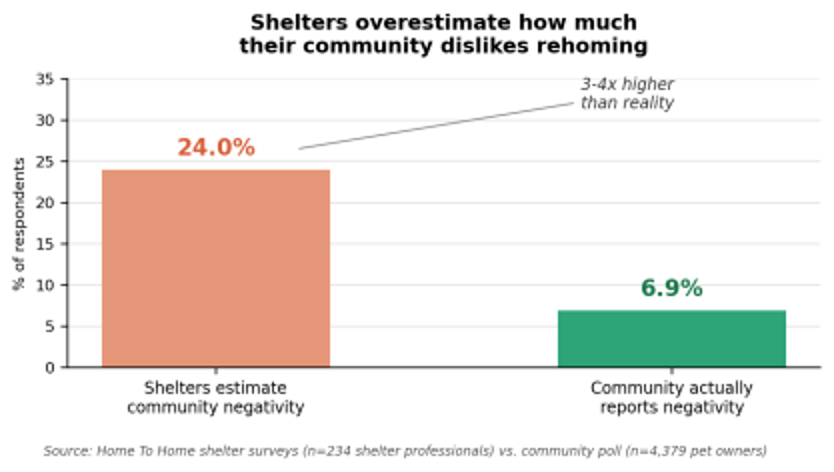
This wasn’t limited to shelters unfamiliar with rehoming. Even organizations actively offering a rehoming program still overestimated community resistance by a wide margin. That suggests it’s a pattern across the whole field.
The intake fear does not hold up against real experience
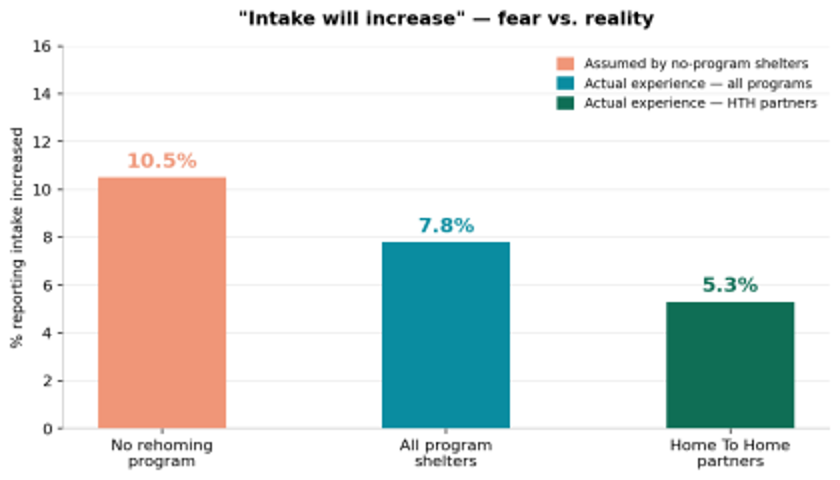
The concern we hear most often is some version of “won’t this just increase our intake?” We compared what shelters actually experienced with what groups without a program assumed was happening.
Shelters without any rehoming program assumed that intake was increasing for their peers at a rate of 10.5 percent. Among shelters that actually run a rehoming program, the real rate of reported intake increases was 7.8 percent. Among Home To Home partner shelters specifically, it was 5.3 percent.
In other words, the fear of increased intake is highest among the organizations with no direct experience to test it against, and it decreases as structured program experience increases.
It is also worth noting that the dominant real-world experience among shelters running any rehoming program is not dramatic intake reduction. The most common outcomes reported were that intake stayed about the same or was better managed through scheduling and delay, and that in itself is a meaningful operational benefit for shelters managing capacity. Home To Home partner shelters, however, reported a notably different picture. They reported “better managed intake” at 21.1 percent, nearly double the rate of the broader program-running group at 14.8 percent, and a lower rate of intake staying the same. In other words, shelters actively partnering with Home To Home were more likely to report that their intake became more controlled and predictable, not just stable.
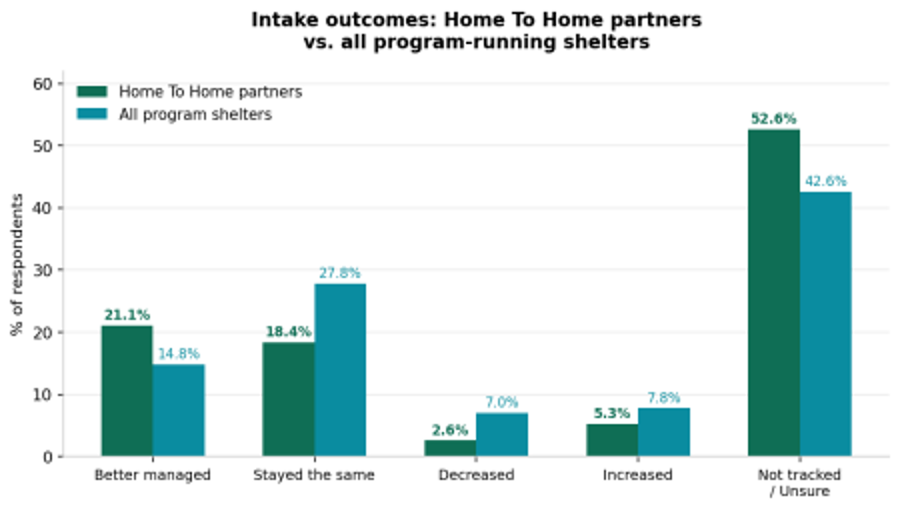
We want to be upfront that this is a correlation, not conclusive proof of cause and effect. It’s possible that shelters willing to try rehoming programs were already more open to this approach before they started. Still, the organizations doing the work are not reporting the outcomes many fear.
You might be doing better than you think
We also ran a separate survey of our active shelter administrators, shared via newsletter and available on their dashboard. One pattern stood out. Shelters using Home To Home personally reported “better managed intake” as their top outcome at 39.5 percent, with a smaller share of 11.6 percent reporting that intake had decreased outright. But when this same group of partners was asked what they believed their peers were experiencing, the assumed rate of decreased intake was noticeably higher than what people were reporting about themselves, jumping to 44.2 percent.
There are two reasonable explanations. One is that shelters are quietly underselling their own success and assuming everyone else is doing better. The other is that many organizations simply aren’t tracking outcomes closely enough to report on them with full confidence, and uncertainty is filling that gap. Either way, better internal tracking would help your organization see its own results more clearly, and help the field build a more accurate shared picture.
Referring is good. Active partnership produces clearer results.
Among organizations connected to Home To Home, we saw a meaningful difference between those actively managing their own listings on the platform and those simply referring people to it as a resource. The organizations actively involved reported very positive attitudes about rehoming at 72.7 percent of the time compared to 60.9 percent among referral-only organizations, in addition to clearer visibility into outcomes.
This points to a practical insight: the benefit of a rehoming program is not just in pointing people toward a resource. It is in staying involved. The shelters seeing the clearest results are the ones remaining close to the process.
Why guardians choose rehoming
Beyond the numbers, a few responses from guardians themselves stood out. Pet owners cited wanting to avoid the risk of euthanasia associated with shelter surrender as a significant reason for choosing to rehome directly. Others described using rehoming as a bridge while waiting on a surrender appointment, which is a meaningful signal: rehoming is working alongside shelter services in these cases, not in competition with them.
The bottom line
The data suggests the biggest barrier to rehoming is not your community. It is the assumptions inside the field itself. Those assumptions do not hold up well once you look at what shelters running programs actually report.
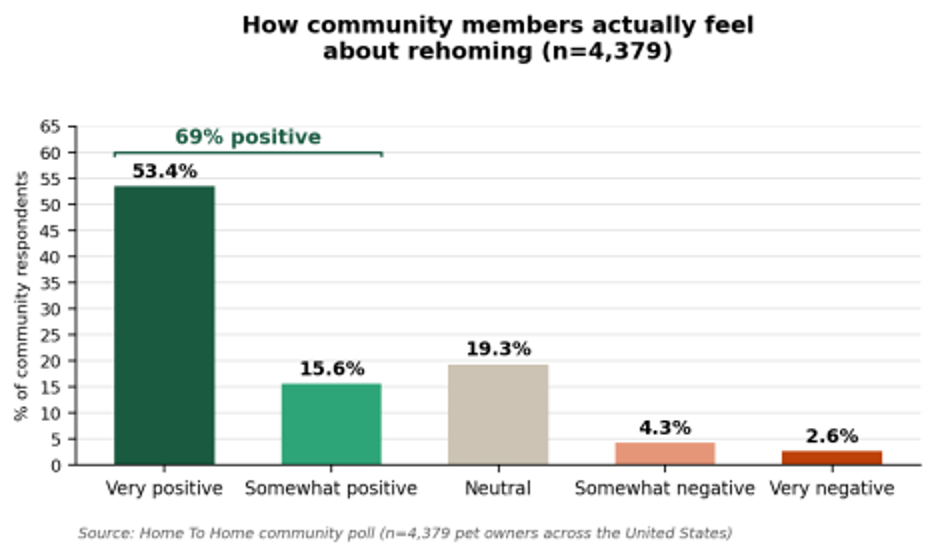
Your community is more open to rehoming than most shelter professionals assume, with 56.7 percent of community members describing their view of rehoming as positive. The feared increases in intake are less common among structured programs than among those with no program at all. And the shelters seeing the clearest results are the ones staying actively involved, tracking their outcomes, and treating rehoming as a supported process rather than a handoff.
If your organization has been on the fence, the evidence points toward trying it and measuring what happens. The results your peers are reporting are more modest than the fear, and more positive than many expect.
Home To Home | Survey Analysis 2025–2026